silver nitrate notes
a personal log of classic cinema
navigation
currently watching
The Passion of Joan of Arc (1928, Dreyer). second viewing this month, on the Norwegian-print restoration.
recent updates
14 apr · published Toland piece
09 apr · archive tidied
02 apr · april watch log added
27 mar · fixed broken Murnau link
14 mar · new guestbook entries
visitors
094,906
mailing list
new posts by email. one a month.
Eisenstein's Odessa Steps and the Grammar of Editing
3 apr 2009
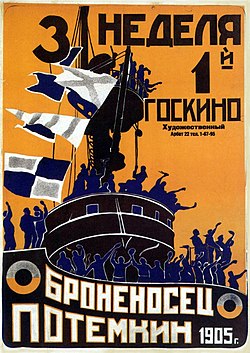 Sergei Eisenstein (1898-1948) was twenty-seven when he directed Battleship Potemkin (1925), his second feature. The Soviet state had commissioned it as a propaganda piece commemorating the twentieth anniversary of the 1905 revolution. What Eisenstein and his cinematographer Eduard Tisse (1897-1961) delivered is a propaganda piece. It is also the film that worked out, on a level of technical detail that shapes every action film made since, what cutting between shots can do.
The famous sequence is the Odessa Steps massacre. Cossack troops advance down the steps toward a crowd of civilians. Eisenstein cuts at a rate that, in 1925, was unusual to the point of being disorienting. Shots are held for seconds, then for half-seconds, then for a dozen frames. The direction of motion reverses between consecutive shots. A pram rolls down the steps; we see it from above, then from below, then from the side. The montage is Eisenstein's entire argument about what cinema does: it is not a recording of reality, it is a manipulation of the viewer's attention through rhythm.
Tisse's contribution is the lighting. The steps sequence was shot over several days in Odessa in flat Black Sea light. Tisse used filtering to bring the sky down to near-black and lit the civilians from the side so that their faces read as distinct in the crowd. Eisenstein's cutting needed Tisse's compositions: every shot had to have a single recognisable element (a face, a flag, a boot) for the cut to register. Without Tisse's framing, the sequence would be chaos. With it, it is a piece of rhythmic counterpoint.
| film | Bronenosets Potyomkin / Battleship Potemkin (1925) |
|---|---|
| director | Sergei Eisenstein (1898-1948) |
| cinematography | Eduard Tisse |
| studio | Mosfilm (Goskino) |
| runtime | 75 min (silent, 24 fps) |
| format | 35mm, 1.33:1 |
The massacre at the Odessa Steps did not, historically, happen. The 1905 unrest in Odessa was violent, but there was no specific staircase massacre. Eisenstein invented it. What is on screen is an event composed for cinema, not a record of what occurred. Whether one finds this acceptable as propaganda depends on one's politics. Whether one finds it effective as editing is not in dispute.
[ « prev: Nanook · next: Metropolis » ]
» leave a comment in the guestbook
sources
[1] Bordwell, David. The Cinema of Eisenstein. Harvard UP, 1993.
[2] Taylor, Richard. The Battleship Potemkin. I.B. Tauris, 2000.
[3] Leyda, Jay. Kino: A History of the Russian and Soviet Film. George Allen & Unwin, 1960.
[4] Eisenstein, Sergei. Film Form, trans. Jay Leyda. Harcourt, 1949.