silver nitrate notes
a personal log of classic cinema
navigation
currently watching
The Passion of Joan of Arc (1928, Dreyer). second viewing this month, on the Norwegian-print restoration.
recent updates
14 apr · published Toland piece
09 apr · archive tidied
02 apr · april watch log added
27 mar · fixed broken Murnau link
14 mar · new guestbook entries
visitors
094,890
mailing list
new posts by email. one a month.
Nanook of the North and the Documentary Lie
10 feb 2009
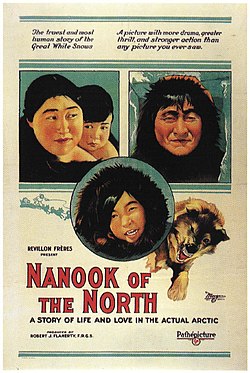 Robert Flaherty (1884-1951) spent most of 1920 and 1921 in Arctic Canada, filming the Inuit family of a man he called Nanook. The film, released in 1922 as Nanook of the North, is commonly called the first feature-length documentary. It is also, by modern standards, a staged film in several respects. Nanook's name was Allakariallak. Several family members in the film were not actually related. The igloo interior was cut open for the lighting. Flaherty supplied the Inuit with old hunting tools for the camera rather than the modern rifles they actually used. What Flaherty claimed to document and what he filmed were not the same thing.
This tension, in the century since, has generated endless argument. Is Nanook a documentary? An ethnographic fiction? A colonial artifact? The short answer is all three. The longer answer is that Flaherty's staging produced, despite itself, documentary footage of practices that were already disappearing when he filmed them. The walrus hunt, the igloo construction, the sled-dog handling: the techniques were authentic even when the circumstances of filming were not. By the time sound cinema arrived, much of what Flaherty staged had ceased to be part of Inuit life.
The cinematography, credited to Flaherty himself, was remarkable for its conditions. He used an Akeley motion-picture camera, a stills-derived design that could be operated in arctic temperatures. The igloo interiors were lit by available winter sunlight through walls cut open for the purpose, an artificial condition that nonetheless produced shadow-lit compositions that predicted the noir aesthetic by twenty years. The exterior long shots, photographed across snow with the sun low on the horizon, use the snow's natural reflective properties as a fill light. Flaherty was not a trained cinematographer. What he had was a visual instinct and a year in which to use it.
| film | Nanook of the North (1922) |
|---|---|
| director | Robert J. Flaherty (1884-1951) |
| cinematography | Robert J. Flaherty |
| subject | Allakariallak and his family, Hudson Bay |
| studio | Revillon Frères / Pathé |
| runtime | 79 min (silent) |
| format | 35mm, 1.33:1 |
Allakariallak died of tuberculosis in 1923, a year after the film's release. Flaherty did not attend his funeral; he was in England preparing his next project. The question of what Flaherty owed to the people he photographed is a question that documentary has not yet finished answering.
[ « prev: The General · next: Potemkin » ]
» leave a comment in the guestbook
sources
[1] Rotha, Paul. Robert J. Flaherty: A Biography. University of Pennsylvania Press, 1983.
[2] Barsam, Richard. The Vision of Robert Flaherty. Indiana UP, 1988.
[3] Rony, Fatimah Tobing. The Third Eye: Race, Cinema, and Ethnographic Spectacle. Duke UP, 1996.
[4] Nichols, Bill. Representing Reality. Indiana UP, 1991.