silver nitrate notes
a personal log of classic cinema
navigation
currently watching
The Passion of Joan of Arc (1928, Dreyer). second viewing this month, on the Norwegian-print restoration.
recent updates
14 apr · published Toland piece
09 apr · archive tidied
02 apr · april watch log added
27 mar · fixed broken Murnau link
14 mar · new guestbook entries
visitors
094,924
mailing list
new posts by email. one a month.
The Big Sleep and the Case We Stopped Trying to Follow
17 feb 2024
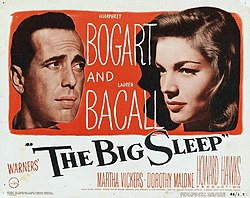 Howard Hawks's The Big Sleep (1946) was adapted from Raymond Chandler's 1939 novel by William Faulkner, Leigh Brackett, and Jules Furthman. The three writers produced a screenplay whose plot nobody involved could fully explain. Hawks later recalled asking Chandler himself whether a particular character had been murdered or had committed suicide; Chandler said he did not know. The film was shot and released anyway. Nobody cared.
The cinematographer was Sidney Hickox (1895-1982), Hawks's regular collaborator since His Girl Friday. What Hickox does on The Big Sleep is work in almost continuous low-key lighting. Almost every scene is an interior at night. The Sternwood mansion is lit by chandeliers; the rare book shop is lit by desk lamps; the gambling den is lit by overhead pendants; the hotel rooms are lit by a single bedside lamp. Hickox is not imitating noir photography of the period; he is establishing it. The Big Sleep is one of the films that, in retrospect, is understood to have defined what noir looks like.
What the film offers that the plot does not is the chemistry between Humphrey Bogart and Lauren Bacall. They had married during the reshoots (Hawks brought Bacall back in for additional scenes when the studio decided the original cut underused her) and the marriage is visible on screen. Their scenes together are photographed at conversational distance with minimal cutting; Hickox holds them in two-shots long enough for the audience to watch the relationship operate.
The racetrack conversation between Marlowe (Bogart) and Vivian (Bacall) is the film's centrepiece. They are ostensibly discussing horses. Every double entendre in the scene is about sex. Every look is about sex. The dialogue, written for the reshoots, is the dialogue the film exists for. Hickox shoots the scene in two-shot with the camera slightly below conversational height, so that the audience looks up at Bogart and Bacall as they look at each other. The scene is about two people who have clearly slept together deciding whether to sleep together again. It is one of the funniest sustained exchanges in American cinema.
| film | The Big Sleep (1946) |
|---|---|
| director | Howard Hawks (1896-1977) |
| cinematography | Sidney Hickox, ASC |
| screenplay | William Faulkner, Leigh Brackett, Jules Furthman |
| stars | Humphrey Bogart, Lauren Bacall |
| studio | Warner Bros. |
| runtime | 114 min (1946 release) |
| format | 35mm, 1.37:1 |
The plot is still incoherent. The film is, nonetheless, one of the best of the decade. Those two observations are not in tension.
[ « prev: Bicycle Thieves · next: Late Spring » ]
» leave a comment in the guestbook
sources
[1] McCarthy, Todd. Howard Hawks: The Grey Fox of Hollywood. Grove, 1997.
[2] Mast, Gerald. Howard Hawks, Storyteller. Oxford UP, 1982.
[3] Wood, Robin. Howard Hawks. Wayne State UP, rev. ed. 2006.
[4] Chandler, Raymond. The Big Sleep. Alfred A. Knopf, 1939.