silver nitrate notes
a personal log of classic cinema
navigation
currently watching
The Passion of Joan of Arc (1928, Dreyer). second viewing this month, on the Norwegian-print restoration.
recent updates
14 apr · published Toland piece
09 apr · archive tidied
02 apr · april watch log added
27 mar · fixed broken Murnau link
14 mar · new guestbook entries
visitors
094,946
mailing list
new posts by email. one a month.
Bicycle Thieves and the Refusal of Composition
2 oct 2023
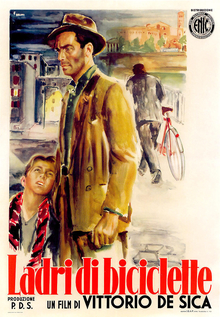 Bicycle Thieves (1948) is the film Italian neorealism is most often summarised by, which is both fair and a little reductive. Vittorio De Sica (1901-1974) and his screenwriter Cesare Zavattini wanted, on their own account, to take cinema back to the street: actual streets, actual non-professional actors, actual light as it fell during the day on an actual working-class neighbourhood of Rome. The film they made delivers on this.
What gets less attention is the work of the cinematographer, Carlo Montuori. Montuori had been shooting films since 1914, mostly routine studio work. Bicycle Thieves asked him to do the opposite of studio work. He was to photograph Rome as he found it, to keep the camera where it needed to be for the story, and not to compose shots for their own sake.
This is easier to say than to do. A career cinematographer knows how to compose. A cinematographer told not to compose, but also told to produce a film that reads legibly on screen, has to work out a new set of habits. Montuori's solution was to photograph the film as a kind of observation. The camera is usually at conversational height. The framing is usually wider than strict composition would require, so that extraneous elements (a passing car, a child in the background, a poster on a wall) remain in shot. The lighting, where possible, is available daylight or available streetlight. When he has to supplement, he supplements as minimally as possible.
The result is a film that does not look composed. It looks observed. The shot of Antonio Ricci (Lamberto Maggiorani) and his son Bruno (Enzo Staiola) walking along the wet pavement of a Roman street, having lost the bicycle that was to let Antonio keep the job he needed to feed his family, is a shot that could have been taken by anyone with a camera who happened to be there that morning. The composition is plain. The light is whatever the sky gave. Montuori is not showing us Rome; he is letting us see it.
The non-professional cast is famous, but the cast is not the reason the film works. The reason is that De Sica, Zavattini, and Montuori had agreed in advance on what the film would refuse to do. It would refuse to tell the audience how to feel. It would refuse to compose for impact. It would refuse to light for beauty. What was left, after all the refusals, is a picture of postwar poverty that has not been bettered.
| film | Ladri di biciclette / Bicycle Thieves (1948) |
|---|---|
| director | Vittorio De Sica (1901-1974) |
| cinematography | Carlo Montuori |
| screenplay | Cesare Zavattini and others, after Luigi Bartolini |
| stars | Lamberto Maggiorani, Enzo Staiola, Lianella Carell |
| studio | Produzioni De Sica |
| runtime | 89 min |
| format | 35mm, 1.37:1 Academy |
André Bazin wrote the single best essay on the film, in Cahiers du Cinéma in 1949, collected in What Is Cinema? (1967). If you read one thing about neorealism, read Bazin.
[ « prev: Madame de... · next: The Big Sleep » ]
» leave a comment in the guestbook
sources
[1] Bazin, André. What Is Cinema?, vol. 2, trans. Hugh Gray. University of California Press, 1971.
[2] Bondanella, Peter. Italian Cinema: From Neorealism to the Present. Continuum, 3rd ed. 2001.
[3] Gordon, Robert S.C. Bicycle Thieves. BFI Film Classics, 2008.
[4] Zavattini, Cesare. "Some Ideas on the Cinema," Sight and Sound, October 1953.