silver nitrate notes
a personal log of classic cinema
navigation
currently watching
The Passion of Joan of Arc (1928, Dreyer). second viewing this month, on the Norwegian-print restoration.
recent updates
14 apr · published Toland piece
09 apr · archive tidied
02 apr · april watch log added
27 mar · fixed broken Murnau link
14 mar · new guestbook entries
visitors
094,901
mailing list
new posts by email. one a month.
Notorious and the Key in the Hand
25 apr 2022
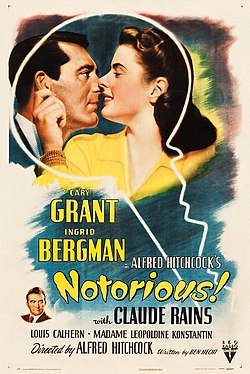 Alfred Hitchcock (1899-1980) directed Notorious (1946) at RKO, produced it himself under a one-film deal, and delivered what is still one of the tightest films of his career. The screenplay was Ben Hecht's. The cast was Ingrid Bergman, Cary Grant, and Claude Rains. The cinematographer was Ted Tetzlaff (1903-1995), an American DP who had worked with Hitchcock once before and who would never work with him again, which is a shame, because what Tetzlaff does in Notorious is, for my money, the best photography Hitchcock ever had on any of his American films.
The plot is a spy thriller. Alicia (Bergman), the daughter of a convicted Nazi, is recruited by an American agent (Grant) to infiltrate a group of Nazi exiles in postwar Rio de Janeiro. She seduces and marries one of them, Sebastian (Rains). The Americans need to find out what Sebastian's group is working on. The answer involves the wine cellar.
The shot people remember is the one at the top of the grand staircase in Sebastian's house. The camera is at the second-floor balcony, looking down into the foyer where Alicia is holding a cocktail party. The camera pulls forward, over the railing, and descends in a long single shot that continues unbroken until it is in close-up on Alicia's hand, which is clenched around a key. The shot is several minutes in duration. The key had been forged on the studio floor to be visible at that distance. The shot was achieved with a camera crane that had to be built for the single setup. Hitchcock's storyboard for the shot is famous; Tetzlaff's execution of it is less so, and shouldn't be.
The wine cellar scene that follows is equally composed. The cellar is a real set, and Tetzlaff lights it with one source, a bare bulb overhead, that throws the shadows of the wine racks across the walls in a grid pattern. Alicia and Devlin (Grant) move through the shadows, searching. When they break a bottle of wine and find what is in it (uranium ore, which in 1946 was still classified and which the FBI later tried to interview Hitchcock about), the camera does not cut. The single-source lighting remains. The discovery is staged in unchanging light.
| film | Notorious (1946) |
|---|---|
| director | Alfred Hitchcock (1899-1980) |
| cinematography | Ted Tetzlaff, ASC |
| screenplay | Ben Hecht |
| stars | Cary Grant, Ingrid Bergman, Claude Rains |
| studio | RKO Radio Pictures |
| runtime | 102 min |
| format | 35mm, 1.37:1 Academy |
The final sequence, on the staircase, with Sebastian watching Devlin walk Alicia out of the house, is photographed so that the camera is always below one of the characters and above another. Hitchcock and Tetzlaff shift the hierarchy through the blocking. Bergman, moving unsteadily (she has been poisoned), is sometimes lifted by Grant into the dominant position in the frame. Rains, photographed in long shot from above for most of the scene, is dimensionless. Notorious is, structurally, a film of three people on a staircase, and who is higher tells us who is in charge. The end of the film is about the three positions rearranging themselves.
[ « prev: La Belle et la Bête · next: Day of Wrath » ]
» leave a comment in the guestbook
sources
[1] Truffaut, François. Hitchcock/Truffaut. Simon & Schuster, rev. ed. 1983.
[2] Spoto, Donald. The Dark Side of Genius: The Life of Alfred Hitchcock. Little, Brown, 1983.
[3] McGilligan, Patrick. Alfred Hitchcock: A Life in Darkness and Light. Regan, 2003.
[4] Freedman, Jonathan. Notorious. BFI Film Classics, 2019.