silver nitrate notes
a personal log of classic cinema
navigation
currently watching
The Passion of Joan of Arc (1928, Dreyer). second viewing this month, on the Norwegian-print restoration.
recent updates
14 apr · published Toland piece
09 apr · archive tidied
02 apr · april watch log added
27 mar · fixed broken Murnau link
14 mar · new guestbook entries
visitors
094,975
mailing list
new posts by email. one a month.
Dreyer's Day of Wrath and the Burden of the Pious
3 jul 2022
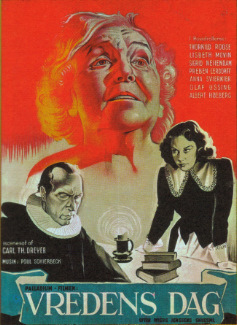 Carl Theodor Dreyer (1889-1968) made Day of Wrath (Vredens Dag, 1943) in occupied Denmark, between The Passion of Joan of Arc (1928) and Ordet (1955), a gap in his feature work that is partly explained by the scarcity of funding available for his kind of cinema in Europe between the wars. The film is set in a seventeenth-century Danish village in the middle of a witch-hunt. The subject, written under Nazi occupation, is authority's right to name and destroy its enemies. Dreyer would later deny any direct allegorical intent. The denial was plausible in 1943 and partial in retrospect.
The cinematographer was Karl Andersson (1908-1975), a Swede, who had worked with Dreyer on a few earlier shorts. The photographic style is closer to Dreyer's Passion than to anything made in European cinema in the years between. Faces are photographed in close-up, often in an almost expressionless register. Interiors are flat-lit with natural sources. The village scenes are shot with such compositional formality that they read, at times, as frozen tableaux. Dreyer had a reputation for slowness and extreme demands on his actors. Day of Wrath confirmed the reputation. The film was shot over many months. Andersson spent weeks lighting single sequences.
The central image of the film is the burning of the old witch, Herlofs Marte. Dreyer and Andersson shoot this not as spectacle but as process. The witch is tied to a ladder, which is hoisted to a vertical position, over which she is slid onto a lit pyre. The camera does not cut away. We watch the process in its entirety. There is no close-up on her face. The camera is across the square, at low angle, with the pyre's smoke rising into the frame. Dreyer makes the audience watch the same event that he has just made his camera watch: the formal execution of a woman who may or may not be guilty and whose guilt is, either way, beside the point.
The film's tragic irony is that the young wife Anne, who is identified by the pious villagers as the witch's successor, may genuinely have the supernatural capacity the village suspects. Dreyer never settles this. The film ends on Anne's face, in close-up, saying nothing. What that face means depends on the viewer's willingness to read it as repentance or as concealed triumph.
| film | Vredens Dag / Day of Wrath (1943) |
|---|---|
| director | Carl Theodor Dreyer (1889-1968) |
| cinematography | Karl Andersson |
| screenplay | Carl Theodor Dreyer, Mogens Skot-Hansen, Poul Knudsen |
| stars | Lisbeth Movin, Thorkild Roose, Preben Lerdorff Rye |
| studio | Palladium Film |
| runtime | 97 min |
| format | 35mm, 1.37:1 |
[ « prev: Notorious · next: Night of the Hunter » ]
» leave a comment in the guestbook
sources
[1] Bordwell, David. The Films of Carl-Theodor Dreyer. University of California Press, 1981.
[2] Drum, Jean and Dale D. Drum. My Only Great Passion: The Life and Films of Carl Th. Dreyer. Scarecrow, 2000.
[3] Carney, Raymond. Speaking the Language of Desire: The Films of Carl Dreyer. Cambridge UP, 1989.
[4] Schrader, Paul. Transcendental Style in Film. University of California Press, 1972.