silver nitrate notes
a personal log of classic cinema
navigation
currently watching
The Passion of Joan of Arc (1928, Dreyer). second viewing this month, on the Norwegian-print restoration.
recent updates
14 apr · published Toland piece
09 apr · archive tidied
02 apr · april watch log added
27 mar · fixed broken Murnau link
14 mar · new guestbook entries
visitors
094,923
mailing list
new posts by email. one a month.
John Alton, T-Men, and the Black That Was Not a Mistake
03 may 2026
Most of the cinematographers I have written about on this site (Toland, Howe, Krasker, Musuraca) had a Hollywood orthodoxy to push back against. John Alton (1901-1996) had something different. He had a poverty-row studio (Eagle-Lion, late of the bankruptcy of Producers Releasing Corporation) that did not have the lights to do conventional cinematography, and he had a director, Anthony Mann, who was happy to shoot anything Alton was prepared to expose. T-Men (1947), their first picture together, is the result of those two compromises pointing in the same direction. The film is shot in the dark because the studio could not afford to light it, and the dark, once Alton had finished with it, became a style.
I want to say plainly: the look of postwar American film noir, which we now treat as a stylistic position about urban paranoia and moral compromise, was largely figured out by a Hungarian-born poverty-row cameraman trying to expose negative film with three quarters of the lighting package the studio promised him.
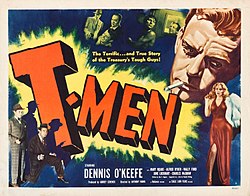 T-Men is a procedural about two Treasury agents (Dennis O'Keefe and Alfred Ryder) who infiltrate a counterfeiting ring. The plot is functional and not the reason anyone has watched the film since 1948. The reason is the camera. Alton lights the picture's interiors at one or two stops below the standard Hollywood key, allows huge portions of the frame to fall to pure black, and uses small hard sources to pick out faces, hands, and the surfaces of objects (rim-light on a coffee cup, key on the brim of a hat, a single lamp behind a desk that puts the agent's face into chiaroscuro). The result is a film that looks, on a 1947 Paramount or MGM screen, almost printed wrong. Audiences at the time complained. Reviewers, including Bosley Crowther in the Times, noted the underexposed look approvingly but without quite knowing what to call it.
Alton called it, in his own writing, low-key. He had been writing in the trade press about his lighting philosophy for the better part of fifteen years by the time T-Men opened, and his book Painting With Light (Macmillan, 1949) is the most clearly written account of the reasoning behind the noir look that we have. The book is worth reading. It is not a memoir; it is a manual. Alton lays out, with the patience of a man who knows he is teaching, the difference between high-key, mid-key, and low-key lighting, the role of fill in establishing a mood, the use of practicals in motivating the look of a scene, and the willingness, central to his entire body of work, to expose negative below the standard Eastman recommendation in order to print rich and contrasty rather than safe and grey. The book's thesis, in a sentence, is that the cinematographer's job is not to render what is in the room but to render what the room means.
| film | T-Men (1947) |
|---|---|
| director | Anthony Mann (1906-1967) |
| cinematography | John Alton (1901-1996) |
| screenplay | John C. Higgins, story by Virginia Kellogg |
| studio | Eagle-Lion Films |
| runtime | 92 min |
| format | 35mm, 1.37:1 Academy |
Mann shot four pictures in a row with Alton (T-Men, Raw Deal, He Walked by Night, Border Incident) between 1947 and 1949, and the run is the most concentrated noir partnership in American cinema. Mann staged scenes in long takes that gave Alton time to build the lighting in depth. Alton built the lighting in depth. The famous steam-bath sequence in T-Men, in which the corrupt informant Moxie (played by Charles McGraw) is trapped behind a locked door and gassed, is photographed almost entirely with hard sources at low angles, the steam catching the beams and rendering the room as a series of vertical bars of light against pure black. The set was tiny. The lighting package, by Alton's account in American Cinematographer in 1948, consisted of three lamps. The result is one of the most quoted compositions in the noir cycle.
What Alton did to film noir, the next generation of American cinematographers carried forward without crediting him very often. Stanley Cortez (The Night of the Hunter) had been shooting low-key since the 1930s, but his late noir work owes Alton. Nicholas Musuraca's RKO output (Cat People, Out of the Past) was developed in parallel rather than in influence. The cinematographers who emerged in the late 1950s on the back of television-studio training and entered features around 1960 (Conrad Hall, Haskell Wexler, William Fraker) had all read Painting With Light and most of them said so in interviews when asked. The book outlived the noir cycle. The technique outlived the studio that bankrolled it.
Alton himself moved to MGM in 1949, shot Vincente Minnelli's musicals, won an Academy Award for the colour ballet sequence in An American in Paris (1951), and retired from cinematography in 1960 at the age of fifty-nine. He lived another thirty-six years and almost never spoke publicly about his work after retirement. The American Society of Cinematographers gave him a Lifetime Achievement Award in 1995, the year before he died. He attended the ceremony, accepted the award, and is reported to have made a short speech in which he thanked his collaborators and said nothing about technique. He had already written it down. The book was on the shelf.
[ « prev: Pather Panchali · next: Trouble in Paradise » ]
» leave a comment in the guestbook
sources
[1] Alton, John. Painting With Light. Macmillan, 1949; reprinted University of California Press, 1995, with an introduction by Todd McCarthy.
[2] Alton, John. "Lighting for T-Men." American Cinematographer, January 1948.
[3] McCarthy, Todd. Introduction to Painting With Light (1995 reissue).
[4] Schrader, Paul. "Notes on Film Noir." Film Comment, Spring 1972.