silver nitrate notes
a personal log of classic cinema
navigation
currently watching
The Passion of Joan of Arc (1928, Dreyer). second viewing this month, on the Norwegian-print restoration.
recent updates
14 apr · published Toland piece
09 apr · archive tidied
02 apr · april watch log added
27 mar · fixed broken Murnau link
14 mar · new guestbook entries
visitors
094,916
mailing list
new posts by email. one a month.
Godard's Breathless and the Jump Cut as Declaration
30 may 2025
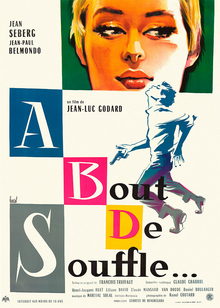 Jean-Luc Godard (1930-2022) directed Breathless (1960) at twenty-nine, his first feature. Truffaut had given him a story treatment he was not going to use. Claude Chabrol agreed to be credited as technical advisor so that Godard could get an insurance bond. Raoul Coutard (1924-2016), a cinematographer fresh from combat documentary work in Indochina, agreed to shoot it with available light and a handheld camera. The budget was about sixty-five thousand dollars.
Breathless is sometimes described as the first Nouvelle Vague feature, which is not quite true (Chabrol's Le Beau Serge preceded it by a year, as did Truffaut's The 400 Blows by months), but it is the film that made the rest of Europe and America pay attention. What the film did, and what the subsequent decade of world cinema would rehearse variations on, is refuse the editing conventions of classical Hollywood and do so visibly.
The famous jump cuts in the Mercedes scene early in the film were not, in Godard's original edit, deliberate. The rough cut was too long. Godard needed to reduce the film by fifteen minutes or so. Rather than tighten scenes in the conventional way (shortening individual shots or removing transitions), he cut within shots, removing frames from the middle of a continuous performance. The result, on screen, is a woman in a car whose position and angle change between frames, as though time were skipping. In 1960 this was unusual to the point of being disorienting. Godard left the jump cuts in the film because he liked what they did.
Coutard's photography made the method visible. He shot with a handheld Éclair camera, which was light enough to be truly mobile, on Ilford HP3 stock pushed a full stop to accommodate available interior light. He worked without additional lights on most Paris exteriors. Long sequences were shot from a wheelchair pushed by Godard. The results are grainier, less consistent, and more visually aggressive than French studio cinema of the period. The image was, in 1960, a statement about what kind of cinema was being made.
| film | À bout de souffle / Breathless (1960) |
|---|---|
| director | Jean-Luc Godard (1930-2022) |
| cinematography | Raoul Coutard |
| screenplay | Jean-Luc Godard, after a treatment by François Truffaut |
| stars | Jean-Paul Belmondo, Jean Seberg |
| studio | Les Films Impéria / Société Nouvelle de Cinématographie |
| runtime | 90 min |
| format | 35mm, 1.37:1 |
Seberg's voiceover in the final scene, repeating a phrase Belmondo had said to her earlier ("I am a bitch," she says, and then "what is a bitch"), was added in post-production after Godard decided the film needed one more rhyme with its own opening. The film ends on a question about language. So does the New Wave.
[ « prev: Hiroshima mon amour · next: Nights of Cabiria » ]
» leave a comment in the guestbook
sources
[1] MacCabe, Colin. Godard: A Portrait of the Artist at 70. Bloomsbury, 2003.
[2] Monaco, James. The New Wave. Oxford UP, 1976.
[3] Andrew, Dudley (ed.). Breathless. Rutgers Films in Print, 1987.
[4] Coutard, Raoul. Interview in Sight and Sound, Winter 1966-67.