silver nitrate notes
a personal log of classic cinema
navigation
currently watching
The Passion of Joan of Arc (1928, Dreyer). second viewing this month, on the Norwegian-print restoration.
recent updates
14 apr · published Toland piece
09 apr · archive tidied
02 apr · april watch log added
27 mar · fixed broken Murnau link
14 mar · new guestbook entries
visitors
094,925
mailing list
new posts by email. one a month.
Truffaut, Decaë, and the Handheld Schoolboy
16 jun 2024
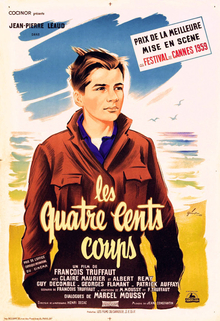 François Truffaut (1932-1984) was twenty-seven when The 400 Blows premiered at Cannes in 1959. He had been writing for Cahiers du Cinéma for six years, attacking the French studio tradition, calling its directors producers of "films of quality" in scare quotes. The film he made in response was partly an argument, partly a confession. Much of the story is Truffaut's own childhood. The stand-in is Jean-Pierre Léaud, who plays Antoine Doinel with an openness that no professional actor Truffaut's age could have given him.
The cinematographer was Henri Decaë (1915-1987), who had come up through the French documentary tradition and had photographed Jean-Pierre Melville's Le Silence de la mer (1949) and Louis Malle's Elevator to the Gallows (1958). Decaë's pre-Nouvelle Vague reputation was for shooting available-light work on equipment lighter than the studio standard. This mattered for Truffaut, whose first feature budget was roughly a tenth of what a French studio picture cost.
Decaë shot The 400 Blows with an Arriflex II on Kodak Plus-X stock, pushed slightly to compensate for low-light interiors. A significant portion of the film is handheld, not because Truffaut wanted a handheld aesthetic but because Decaë's equipment was light enough to permit it and because the streets of Paris in winter 1958 could not be blocked off for a dolly track. The handheld sections read now, sixty-five years later, as a stylistic choice. In 1959 they were a practical one that turned into a stylistic choice because the filmmakers liked what it did.
Look at the sequence on the rotor at the fairground, where Antoine steps into the spinning drum and is pressed against the wall by centrifugal force. Decaë put the camera inside the drum with him. There is no way to light the interior of a rotor cleanly; he used a single bulb on the far wall and let the exposures fall as they fell. Antoine's face flashes in and out of the shadow as the drum turns. The sequence is a child's face laughing in varying degrees of darkness. It is also a decent summary of what the New Wave would spend the next decade working out.
| film | Les Quatre Cents Coups / The 400 Blows (1959) |
|---|---|
| director | François Truffaut (1932-1984) |
| cinematography | Henri Decaë |
| screenplay | François Truffaut and Marcel Moussy |
| star | Jean-Pierre Léaud (b. 1944) |
| studio | Les Films du Carrosse / SEDIF |
| runtime | 99 min |
| format | 35mm, 2.35:1 Dyaliscope |
The closing shot is the famous one. Antoine, having escaped from the reformatory, runs to the sea. Decaë tracks him from a car, the camera held by hand through the open window, for what is one of the longest handheld tracking shots in French cinema up to that point. Antoine reaches the water, turns, looks toward the camera. The film freezes on his face. The freeze-frame at a story's climax was not, in 1959, an established convention. It became one, largely because of this shot.
Truffaut dedicated the film to André Bazin, who had died three months before Cannes and did not live to see his protégé's first feature. Bazin would have written the best review of it. Everyone else tried.
[ « prev: Late Spring · next: Casablanca » ]
» leave a comment in the guestbook
sources
[1] de Baecque, Antoine and Serge Toubiana. Truffaut: A Biography, trans. Catherine Temerson. Knopf, 1999.
[2] Monaco, James. The New Wave: Truffaut, Godard, Chabrol, Rohmer, Rivette. Oxford UP, 1976.
[3] Decaë, Henri. Interview in American Cinematographer, March 1968.
[4] Truffaut, François. "Une certaine tendance du cinéma français," Cahiers du Cinéma 31, January 1954.