silver nitrate notes
a personal log of classic cinema
navigation
currently watching
The Passion of Joan of Arc (1928, Dreyer). second viewing this month, on the Norwegian-print restoration.
recent updates
14 apr · published Toland piece
09 apr · archive tidied
02 apr · april watch log added
27 mar · fixed broken Murnau link
14 mar · new guestbook entries
visitors
094,964
mailing list
new posts by email. one a month.
Shadow of a Doubt and Hitchcock's American Town
22 aug 2020
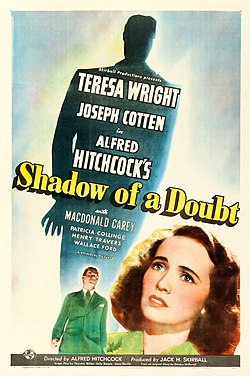 Alfred Hitchcock made Shadow of a Doubt (1943) in the second year of his American career, and on his own account it was his favourite of his own films. The screenplay was by Thornton Wilder, the American playwright, whose sensibility is visible in the film's patient, small-town opening and its turn toward uncanny. The cinematographer was Joseph Valentine (1900-1949), not one of Hitchcock's regular collaborators, who shot the film entirely on location in the northern California town of Santa Rosa.
The premise is Hitchcock's essential one, compressed to its minimum. Young Charlie Newton (Teresa Wright), a teenager in a quiet American town, idolises her charming uncle Charles (Joseph Cotten). Uncle Charles arrives for a visit. Over several days, Charlie realises that her uncle is the Merry Widow Murderer, a serial killer of wealthy widows who has fled east to evade capture. The film turns on the progressive recognition. Nothing supernatural happens. What Charlie sees in her uncle is what a niece sees in an uncle when the niece stops being a child.
Valentine's photography is Santa Rosa photographed straight. The town is lit naturally, mostly in broad daylight. Houses have front porches. The main street has small shops. Hitchcock and Valentine do not stylise the setting in the way Hitchcock's earlier British films had stylised London. The small town is photographed in the register of Thornton Wilder's Our Town, which is one of Wilder's published plays that the audience in 1943 would have known.
What Hitchcock and Valentine do with Cotten, the uncle, is break the register at key moments. Most of Cotten's scenes are lit as flatly as the town around him. But at specific moments, Hitchcock cuts in a close-up lit from below, in a slightly lower key, that breaks the naturalistic frame. Cotten's face registers as slightly off, not demonic, just wrong. The cuts are brief. Valentine does not dwell. The effect is cumulative. By the third or fourth close-up, the audience has registered what Charlie is registering: this man is not what he seems.
| film | Shadow of a Doubt (1943) |
|---|---|
| director | Alfred Hitchcock (1899-1980) |
| cinematography | Joseph Valentine, ASC |
| screenplay | Thornton Wilder, Sally Benson, Alma Reville |
| stars | Teresa Wright, Joseph Cotten |
| studio | Universal Pictures |
| runtime | 108 min |
| format | 35mm, 1.37:1 |
Hitchcock liked the film, he said later, because it was the one film of his where the menace was in the same frame as the idyll, and neither was separable from the other. He spent the next thirty years trying to reproduce the trick. He succeeded occasionally. Shadow of a Doubt is where he first did it.
[ « prev: Diary of a Country Priest · next: On the Waterfront » ]
» leave a comment in the guestbook
sources
[1] Truffaut, François. Hitchcock/Truffaut. Simon & Schuster, rev. ed. 1983.
[2] Spoto, Donald. The Dark Side of Genius: The Life of Alfred Hitchcock. Little, Brown, 1983.
[3] McGilligan, Patrick. Alfred Hitchcock: A Life in Darkness and Light. Regan, 2003.
[4] Hurley, Neil P. Soul in Suspense: Hitchcock's Fright and Delight. Scarecrow, 1993.