silver nitrate notes
a personal log of classic cinema
navigation
currently watching
The Passion of Joan of Arc (1928, Dreyer). second viewing this month, on the Norwegian-print restoration.
recent updates
14 apr · published Toland piece
09 apr · archive tidied
02 apr · april watch log added
27 mar · fixed broken Murnau link
14 mar · new guestbook entries
visitors
094,962
mailing list
new posts by email. one a month.
To Be or Not to Be and the Comedy of Occupation
12 apr 2019
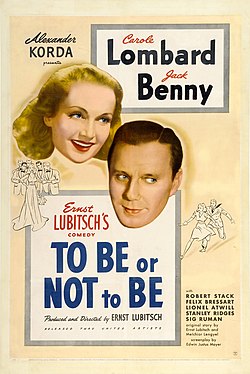 Ernst Lubitsch (1892-1947) directed To Be or Not to Be (1942) at United Artists during the war, with Carole Lombard and Jack Benny as the leads. The cinematographer was Rudolph Maté (whom we have met on The Passion of Joan of Arc fifteen years earlier). What Lubitsch produced is a comedy about a Polish theatre troupe that uses its acting skills to outwit the Gestapo in occupied Warsaw.
The film was released in February 1942, a month after Carole Lombard's death in a plane crash on a war-bond tour. The release was fraught. Critics, and some audiences, found the timing of a Nazi-themed comedy uncomfortable. The film was a moderate commercial success at best. Its reputation grew over the next thirty years, as audiences came to recognise that what Lubitsch had done was not light entertainment but moral satire of an extremely sharp kind.
Maté's photography is conventional studio work for the period, lit cleanly and shot at conversational distance. What Lubitsch does within those frames is more interesting. He places his actors in such a way that the audience can read the acted-versus-real performance at multiple levels simultaneously. Benny's character, the vain ham actor Joseph Tura, plays himself, plays Hitler, plays a Gestapo officer, plays Hamlet, plays a fictitious Polish professor, all within the film's running time. Lubitsch keeps the camera close enough to read Benny's face during each shift but at a distance that preserves the comedy's spatial intelligibility.
The famous line is the one Sig Ruman delivers as Colonel Ehrhardt: "What he did to Shakespeare, we are now doing to Poland." The line is, in 1942, a difficult joke. Lubitsch knew it was difficult. He kept it in the film anyway. It is the line on which the film's whole moral case hangs.
| film | To Be or Not to Be (1942) |
|---|---|
| director | Ernst Lubitsch (1892-1947) |
| cinematography | Rudolph Maté, ASC |
| screenplay | Edwin Justus Mayer, story by Lubitsch and Melchior Lengyel |
| stars | Carole Lombard, Jack Benny, Robert Stack, Sig Ruman |
| studio | Romaine Film Corporation / United Artists |
| runtime | 99 min |
| format | 35mm, 1.37:1 |
The remake by Mel Brooks in 1983 is enjoyable. It does not approach the original.
[ « prev: Stray Dog · next: Sullivan's Travels » ]
» leave a comment in the guestbook
sources
[1] Eyman, Scott. Ernst Lubitsch: Laughter in Paradise. Simon & Schuster, 1993.
[2] Paul, William. Ernst Lubitsch's American Comedy. Columbia UP, 1983.
[3] Insdorf, Annette. Indelible Shadows: Film and the Holocaust. Cambridge UP, 3rd ed. 2003.
[4] Mayer, Edwin Justus. Screenplay (in Three Screen Comedies, Faber, 1991).