silver nitrate notes
a personal log of classic cinema
navigation
currently watching
The Passion of Joan of Arc (1928, Dreyer). second viewing this month, on the Norwegian-print restoration.
recent updates
14 apr · published Toland piece
09 apr · archive tidied
02 apr · april watch log added
27 mar · fixed broken Murnau link
14 mar · new guestbook entries
visitors
094,974
mailing list
new posts by email. one a month.
Ford's Grapes of Wrath and Toland's Camera for the Poor
15 apr 2018
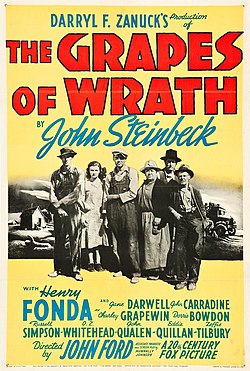 John Ford's The Grapes of Wrath (1940) was the second film in which Gregg Toland experimented with the deep-focus techniques he would perfect on Citizen Kane a year later. (The first was Ford's The Long Voyage Home, also 1940.) Toland was on loan from Goldwyn to Fox for both pictures. Ford got what no other director got that year: the best American cinematographer of his generation, working out a method in real time on location in the Oklahoma panhandle and the California migrant camps.
Ford shot the film from Steinbeck's novel in sequence, a rare decision for a studio production at the time. The family's journey west is traced across actual American highway. Toland photographed the exterior sequences using available daylight and rated his stock low for shadow detail. The interiors of the migrant-camp tents, the shacks, the roadside diners are lit by single sources that motivate the shadow falling across multiple characters. The visual argument of the film is that poverty is photographed in the same vocabulary whether the subject is a face, a hand, or a dust-choked road.
The famous shot is the one of Henry Fonda as Tom Joad delivering the "I'll be there" monologue in a roadside camp at night. Toland has a single low key source below Fonda's jawline, which catches the underside of his chin and the bottom of his lower lip. The rest of his face is in mid-shadow. The camera is at conversational height, slightly below. The monologue lasts nearly two minutes. Ford does not cut. Toland does not move. The shot is, visually, the most famous thing in the film.
Ford won Best Director for Grapes of Wrath at the 1941 Academy Awards. Toland did not win Best Cinematography; that went to George Barnes for Rebecca, which is a perfectly respectable film that nobody now thinks was better shot than Grapes of Wrath. Awards, then and now, are not a reliable record.
| film | The Grapes of Wrath (1940) |
|---|---|
| director | John Ford (1894-1973) |
| cinematography | Gregg Toland, ASC |
| screenplay | Nunnally Johnson, after John Steinbeck |
| stars | Henry Fonda, Jane Darwell, John Carradine |
| studio | 20th Century Fox |
| runtime | 129 min |
| format | 35mm, 1.37:1 |
The film was initially banned in several Oklahoma county libraries (not cinemas; libraries) for Steinbeck's portrayal of the state. The film was less controversial than the novel, partly because Ford softened the ending and partly because Toland's photography was so formally accomplished that reviewers had difficulty treating the film as propaganda.
[ « prev: Drunken Angel · next: Mr. Smith Goes to Washington » ]
» leave a comment in the guestbook
sources
[1] Eyman, Scott. Print the Legend: The Life and Times of John Ford. Simon & Schuster, 1999.
[2] McBride, Joseph. Searching for John Ford. St. Martin's, 2001.
[3] Bordwell, David. On the History of Film Style. Harvard UP, 1997.
[4] Toland, Gregg. "Realism in The Grapes of Wrath," American Cinematographer, April 1940.