silver nitrate notes
a personal log of classic cinema
navigation
currently watching
The Passion of Joan of Arc (1928, Dreyer). second viewing this month, on the Norwegian-print restoration.
recent updates
14 apr · published Toland piece
09 apr · archive tidied
02 apr · april watch log added
27 mar · fixed broken Murnau link
14 mar · new guestbook entries
visitors
094,887
mailing list
new posts by email. one a month.
Dreyer's Ordet and the Resurrection That Does Not Arrive in Colour
25 aug 2017
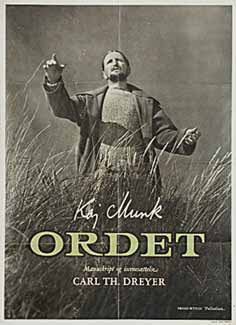 Carl Theodor Dreyer made Ordet (The Word, 1955) seven years after Day of Wrath. He had made one film in between, Two People (1945), which he disowned. Ordet was his return to the long, formal, unhurried cinema of Passion and Wrath. It was also his first film in which a literal miracle occurs on screen.
The cinematographer was Henning Bendtsen (1925-2019), who would also photograph Dreyer's final film Gertrud (1964). Bendtsen shot Ordet on a Danish farm set built for the production. The exterior is a low rambling farmhouse on the Jutland coast. The interior is a series of plain, whitewashed rooms. The lighting is almost entirely natural. Window sources dominate. Bendtsen uses minimal fill.
What Dreyer and Bendtsen do in Ordet that they could not have done in Day of Wrath is refuse the melodramatic lighting of religious narrative. The film's subject is as extreme as religious subjects get: a young man who believes he is Christ; the death in childbirth of his brother's wife; the question of whether faith can raise the dead. A studio film in any era would have lit the final sequence to signal transcendence. Dreyer and Bendtsen refuse. The resurrection scene is lit exactly as the preceding scenes were lit: natural light through the same windows, the same walls, the same plain composition. What happens on screen is not marked by the photography as a miracle. It just happens.
The long takes are part of the same argument. The average shot length in Ordet is over a minute. Characters enter and leave the frame in walking time. The camera moves occasionally, mostly in slow tracks along the walls of the farmhouse, never to emphasise a particular character. If there is emphasis, it is in what the actors are doing, not what the camera is doing about them.
| film | Ordet / The Word (1955) |
|---|---|
| director | Carl Theodor Dreyer (1889-1968) |
| cinematography | Henning Bendtsen |
| stars | Henrik Malberg, Emil Hass Christensen, Preben Lerdorff Rye, Birgitte Federspiel |
| studio | Palladium Film |
| runtime | 126 min |
| format | 35mm, 1.37:1 |
The film won the Golden Lion at Venice in 1955 and opened Dreyer's reputation in the English-speaking world. Most of the commentary has focused on the theological questions. I am not sure the film is actually about theology. I think it is about the patience required to photograph a world that might, at any moment, contain a miracle.
[ « prev: Anatomy of a Murder · next: Paths of Glory » ]
» leave a comment in the guestbook
sources
[1] Bordwell, David. The Films of Carl-Theodor Dreyer. University of California Press, 1981.
[2] Carney, Raymond. Speaking the Language of Desire: The Films of Carl Dreyer. Cambridge UP, 1989.
[3] Drum, Jean and Dale D. Drum. My Only Great Passion. Scarecrow, 2000.
[4] Schrader, Paul. Transcendental Style in Film. University of California Press, 1972.