silver nitrate notes
a personal log of classic cinema
navigation
currently watching
The Passion of Joan of Arc (1928, Dreyer). second viewing this month, on the Norwegian-print restoration.
recent updates
14 apr · published Toland piece
09 apr · archive tidied
02 apr · april watch log added
27 mar · fixed broken Murnau link
14 mar · new guestbook entries
visitors
094,876
mailing list
new posts by email. one a month.
Psycho and the Shower Sequence as Editing Argument
27 may 2016
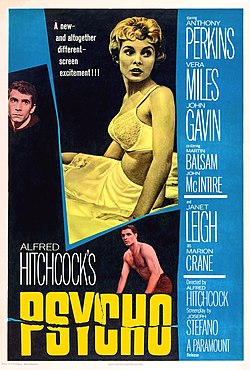 Alfred Hitchcock made Psycho (1960) with his own money when Paramount refused to finance it. He shot the film on a reduced budget of around $800,000 using his television crew from Alfred Hitchcock Presents. The cinematographer was John L. Russell (1905-1967), a television DP who had not previously worked on a Hitchcock feature. What Hitchcock wanted from Russell was fast, efficient photography at television pace. What he got was a film that redefined the horror cinema of the following decade.
The film was shot in black and white because Hitchcock believed a colour film of this material would have been refused a Production Code certificate. The shower sequence in colour would have read as a slasher horror; in black and white, Hitchcock argued, the violence abstracts into compositional geometry. The studio accepted the argument. The film was made in monochrome.
The shower sequence, thirty-four seconds on screen, took seven days to shoot and contains seventy-eight camera setups and about fifty cuts. Hitchcock and his editor George Tomasini built the sequence as a montage in the Eisensteinian sense: the cuts themselves produce the audience's understanding of what is happening. Marion Crane (Janet Leigh) is never shown being stabbed. We see the knife. We see her face. We see the showerhead from below. We see water on tile. We see a hand. We see skin. Nothing in the sequence shows blade meeting body. The audience, watching, believes it has seen the stabbing. It has not.
Russell's photography in the rest of the film is television-fast. The Bates Motel set was built on the Universal backlot. The Bates house on the hill behind the motel was a facade. Russell lit everything in a low-key register that emphasised depth and shadow. Janet Leigh's half-hour as the protagonist, before the shower sequence, is photographed in a conventional 1960 American studio mode. The shift to the shower sequence and its aftermath is a shift in register that the photography makes visible before the story does.
| film | Psycho (1960) |
|---|---|
| director | Alfred Hitchcock (1899-1980) |
| cinematography | John L. Russell, ASC |
| screenplay | Joseph Stefano, after Robert Bloch |
| stars | Anthony Perkins, Janet Leigh, Vera Miles |
| studio | Shamley Productions / Paramount |
| runtime | 109 min |
| format | 35mm, 1.85:1 |
[ « prev: Strangers on a Train · next: Ugetsu » ]
» leave a comment in the guestbook
sources
[1] Rebello, Stephen. Alfred Hitchcock and the Making of Psycho. Dembner, 1990.
[2] Truffaut, François. Hitchcock/Truffaut. Simon & Schuster, rev. ed. 1983.
[3] Naremore, James. Filmguide to Psycho. Indiana UP, 1973.
[4] McGilligan, Patrick. Alfred Hitchcock: A Life in Darkness and Light. Regan, 2003.