silver nitrate notes
a personal log of classic cinema
navigation
currently watching
The Passion of Joan of Arc (1928, Dreyer). second viewing this month, on the Norwegian-print restoration.
recent updates
14 apr · published Toland piece
09 apr · archive tidied
02 apr · april watch log added
27 mar · fixed broken Murnau link
14 mar · new guestbook entries
visitors
094,917
mailing list
new posts by email. one a month.
Pandora's Box and the Face of Louise Brooks
23 jul 2012
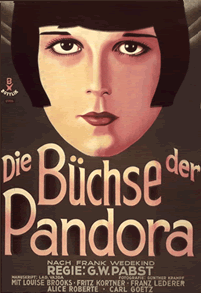 G.W. Pabst (1885-1967) directed Pandora's Box (Die Büchse der Pandora, 1929) at the end of the silent era in Germany, with the American actress Louise Brooks (1906-1985) in the lead role. Brooks was twenty-two. She had been under contract at Paramount, had turned down a sound-era renewal over a salary dispute, and had sailed to Berlin to work for Pabst because her American career was already effectively ending. What she and Pabst and his cinematographer Günther Krampf (1899-1950) made in Berlin that year is, depending on which critic you read, the greatest silent film ever made by an American actress, or the film that buried Brooks in a role she could not escape.
The source is Frank Wedekind's two Lulu plays from the 1890s. Lulu is a young woman who destroys everyone who falls in love with her, not out of malice but because her openness to the world and to desire is incompatible with the moral framework of the men around her. Pabst and Brooks play her without judgement. The film does not frame her as a femme fatale in the noir sense. She is not scheming. Events happen to the men; she is the light source.
Krampf photographs Brooks in a consistent mode throughout. She is almost always in a key light higher than the other characters in the frame, which gives her face a soft glow against the deeper shadows around her. The bob haircut she made iconic was photographed from angles that never fully showed its structure; Krampf keeps the hair as a black mass framing the face. The effect is that Brooks's face is, on screen, a brightness in a room. You cannot read it as a specific psychology. She is weather.
| film | Die Büchse der Pandora / Pandora's Box (1929) |
|---|---|
| director | G.W. Pabst (1885-1967) |
| cinematography | Günther Krampf |
| screenplay | Ladislaus Vajda, after Wedekind |
| star | Louise Brooks (1906-1985) |
| studio | Nero-Film AG |
| runtime | 133 min (silent) |
| format | 35mm, 1.33:1 |
The film was a failure on release in 1929, partly because German audiences resented the casting of an American, partly because the sound era had arrived and the theatres were reluctant to run silents. Brooks returned to America, made a few films, left the industry. She spent most of her life out of work before film scholars, particularly James Card at the George Eastman House, began recovering her reputation in the 1950s.
[ « prev: L'Atalante · next: Wings » ]
» leave a comment in the guestbook
sources
[1] Brooks, Louise. Lulu in Hollywood. Knopf, 1982.
[2] Paris, Barry. Louise Brooks. Knopf, 1989.
[3] Atwell, Lee. G.W. Pabst. Twayne, 1977.
[4] Eisner, Lotte. The Haunted Screen. University of California Press, 1969.