silver nitrate notes
a personal log of classic cinema
navigation
currently watching
The Passion of Joan of Arc (1928, Dreyer). second viewing this month, on the Norwegian-print restoration.
recent updates
14 apr · published Toland piece
09 apr · archive tidied
02 apr · april watch log added
27 mar · fixed broken Murnau link
14 mar · new guestbook entries
visitors
094,892
mailing list
new posts by email. one a month.
Steamboat Bill Jr and the House Falls
30 apr 2011
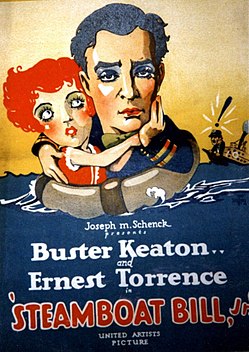 Buster Keaton's Steamboat Bill, Jr. (1928) was his last fully independent production. The following year, his contract was sold to MGM, and he never again had directorial control over his own material. Steamboat Bill, Jr. is the film Keaton made when he had the most money and the most freedom. The cinematography was by Devereaux Jennings and Bert Haines, both Keaton regulars. The film is also the source of one of the two or three most famous stunts in silent cinema.
The stunt is the falling-facade gag. Keaton stands in front of a Mississippi riverboat-town house during a cyclone. The entire facade of the house, weighing two tonnes, falls forward toward him. He is saved because an open upstairs window passes over him as the facade lands. The clearance, top and bottom, is approximately two inches on either side of Keaton's body. One wrong measurement would have killed him.
Keaton insisted on shooting the gag in one take. The facade was real. The window was cut to match Keaton's exact position. His crew, by multiple contemporary accounts, refused to operate the camera. Some of them left the set during shooting. Keaton asked for volunteers and got a minimal crew. The shot, on screen, lasts about two seconds. Keaton does not react. He stands still. The facade falls. The window passes over him. He walks on.
The cyclone sequence around the stunt is equally technical. Keaton and his crew built a large-scale town set that could be disassembled by high-powered industrial fans and mechanical rigs. Buildings collapse on cue. Roofs tear off. Keaton is thrown by the wind across a dozen setups, most of them genuinely blown by the fans. The sequence represents a level of production commitment to a gag that no studio comedy of the period would have matched.
| film | Steamboat Bill, Jr. (1928) |
|---|---|
| director | Charles Reisner (Keaton uncredited) |
| cinematography | Devereaux Jennings and Bert Haines |
| star | Buster Keaton |
| studio | Buster Keaton Productions / United Artists |
| runtime | 70 min (silent) |
| format | 35mm, 1.33:1 |
[ « prev: Sunrise · next: Brief Encounter » ]
» leave a comment in the guestbook
sources
[1] Dardis, Tom. Keaton: The Man Who Wouldn't Lie Down. Scribner, 1979.
[2] Meade, Marion. Buster Keaton: Cut to the Chase. HarperCollins, 1995.
[3] Knopf, Robert. The Theater and Cinema of Buster Keaton. Princeton UP, 1999.
[4] Keaton, Buster. My Wonderful World of Slapstick. Doubleday, 1960.