silver nitrate notes
a personal log of classic cinema
navigation
currently watching
The Passion of Joan of Arc (1928, Dreyer). second viewing this month, on the Norwegian-print restoration.
recent updates
14 apr · published Toland piece
09 apr · archive tidied
02 apr · april watch log added
27 mar · fixed broken Murnau link
14 mar · new guestbook entries
visitors
094,872
mailing list
new posts by email. one a month.
Lang's M and the First Whistle in Cinema
14 sep 2011
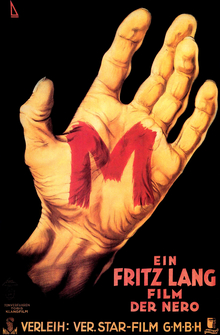 Fritz Lang's M (1931) is the film I recommend to anyone who tells me they do not understand what "sound design" means. Lang and his cinematographer Fritz Arno Wagner, working on Lang's first sound picture, made decisions in 1931 about how sound could work in the new medium that most of their contemporaries would not catch up with for another decade.
The premise is straightforward. A serial killer of children, Hans Beckert (Peter Lorre), is loose in a nameless German city. The police cannot catch him. The criminal underworld, whose operations are being disrupted by the police attention, decides to catch him themselves. The film is equal parts police procedural, social satire, and horror.
What Lang does with sound is radical. Beckert announces himself by whistling "In the Hall of the Mountain King" from Grieg's Peer Gynt. The whistle is the first sound associated with the killer, before we see his face, and it becomes the mechanism by which he is eventually identified: a blind balloon-seller recognises him by the tune alone. The whistle functions as cinema's first genuine sound leitmotif. In 1931 this was a new idea.
Lang and Wagner also worked out what we now call asynchronous sound. The image shows one thing; the audio track is telling us about something else. A mother prepares her daughter's lunch while the girl's empty chair at the table is photographed in silence on screen; the mother's voice offscreen calls her daughter's name against the empty chair. The tension is entirely audio-visual. It is a technique Hitchcock would build a career on twenty years later.
Wagner's photography is as contained as Lang's sound is free. Most of the film is shot in tight, low-ceilinged interiors, the camera close to the actors, the frame cropped to exclude the city. The underworld meeting scenes are composed like courtroom paintings. Lang uses shadow architecturally: the shot of Beckert hiding in the attic of the warehouse, lit by a single bulb that casts his shadow large on the rafters, is a composition Cortez will echo in The Night of the Hunter a quarter-century later.
| film | M (1931) |
|---|---|
| director | Fritz Lang (1890-1976) |
| cinematography | Fritz Arno Wagner |
| screenplay | Thea von Harbou and Fritz Lang |
| star | Peter Lorre (1904-1964) |
| studio | Nero-Film AG |
| runtime | 111 min |
| format | 35mm, 1.19:1 Movietone |
The film's final sentence, delivered by a mother of one of the victims, is the line that survives every re-viewing: "This will not bring our children back."
[ « prev: Brief Encounter · next: The Last Laugh » ]
» leave a comment in the guestbook
sources
[1] McGilligan, Patrick. Fritz Lang: The Nature of the Beast. St. Martin's, 1997.
[2] Gunning, Tom. The Films of Fritz Lang: Allegories of Vision and Modernity. BFI, 2000.
[3] Kaes, Anton. M. BFI Film Classics, 2000.
[4] Eisner, Lotte. Fritz Lang. Secker & Warburg, 1976.