silver nitrate notes
a personal log of classic cinema
navigation
currently watching
The Passion of Joan of Arc (1928, Dreyer). second viewing this month, on the Norwegian-print restoration.
recent updates
14 apr · published Toland piece
09 apr · archive tidied
02 apr · april watch log added
27 mar · fixed broken Murnau link
14 mar · new guestbook entries
visitors
094,938
mailing list
new posts by email. one a month.
Safety Last and Harold Lloyd on the Clock
22 jul 2010
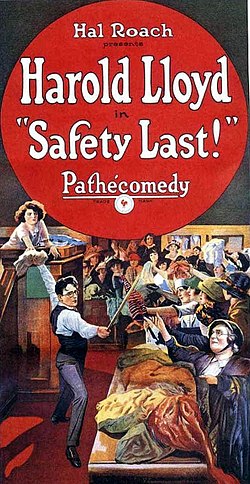 Harold Lloyd (1893-1971) was, through the 1920s, more commercially successful than either Chaplin or Keaton. His films made more money. His films also had fewer pretensions. Safety Last! (1923), directed by Fred C. Newmeyer and Sam Taylor, is the film Lloyd is remembered for, largely because of a single image: his bespectacled character hanging from the hands of a large clock twelve stories above a downtown Los Angeles street.
The clock sequence is technical. The building Lloyd appears to climb is real, but the climb was staged on an abbreviated set built on the roof of a nearby building. Lloyd is always one or two stories above an actual platform that is out of frame. The camera is positioned so that the street below is visible in the background. If he falls, he falls a short distance onto a platform. The danger is structural, not fatal. The audience, in 1923, did not know this. The audience, watching on clean transfers today, often still does not realise it.
Lloyd had, by 1923, already lost two fingers on his right hand to a prop bomb that turned out to be real. He performed the clock sequence with a prosthetic hand and a reduced grip. What he is doing, physically, is harder than it looks, not because the danger is real but because the performance required him to sustain specific comedic postures while holding on with compromised hands.
The cinematography, by Walter Lundin, is conventional comedy lighting. The interest is in the blocking. Newmeyer and Taylor staged the climb in a way that lets us see the street far below in the same frame as Lloyd's face. The danger is spatial, not theatrical. The audience experiences the height because the composition lets them.
| film | Safety Last! (1923) |
|---|---|
| directors | Fred C. Newmeyer and Sam Taylor |
| cinematography | Walter Lundin |
| star | Harold Lloyd (1893-1971) |
| studio | Hal Roach Studios / Pathé |
| runtime | 73 min (silent) |
| format | 35mm, 1.33:1 |
[ « prev: Caligari · next: Modern Times » ]
» leave a comment in the guestbook
sources
[1] Vance, Jeffrey and Suzanne Lloyd. Harold Lloyd: Master Comedian. Abrams, 2002.
[2] Dardis, Tom. Harold Lloyd: The Man on the Clock. Viking, 1983.
[3] Brownlow, Kevin. The Parade's Gone By.... University of California Press, 1968.
[4] Lloyd, Harold. An American Comedy. Longmans, Green, 1928.