silver nitrate notes
a personal log of classic cinema
navigation
currently watching
The Passion of Joan of Arc (1928, Dreyer). second viewing this month, on the Norwegian-print restoration.
recent updates
14 apr · published Toland piece
09 apr · archive tidied
02 apr · april watch log added
27 mar · fixed broken Murnau link
14 mar · new guestbook entries
visitors
094,908
mailing list
new posts by email. one a month.
Stagecoach and the Death of the Western Backlot
12 nov 2009
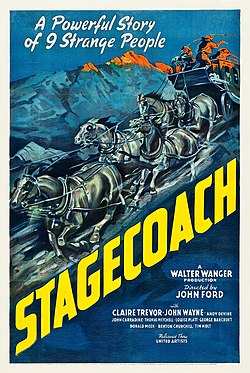 By 1939 the Western was, in commercial terms, dead. The genre had survived the silent era as the studios' workhorse output, but the talkies had pushed it down to the B-picture lots. Producer Walter Wanger struggled for months to find financing for Stagecoach. Three studios passed. United Artists bought it on Wanger's promise that John Ford would deliver something the public had not seen.
Ford delivered Monument Valley.
This was the first of Ford's films to be shot there. The decision was practical (his location scout found cooperation from the Navajo Nation, who would supply most of the extras and many of the horses) and aesthetic (the buttes gave him scale). Bert Glennon (1893-1967), Ford's cinematographer here, photographed the valley with the camera tilted up so that the rock formations dwarf the stagecoach as it crosses a valley floor that runs from the bottom of the frame to a horizon halfway up the image. The composition is almost ridiculous: a tiny coach against rock walls a thousand feet high. The composition becomes the whole point. The trip is impossible. The travellers are insignificant. The land is everything.
What Glennon does inside the coach is equally important. The interior scenes were shot in the studio, the actors crammed into a coach interior built for the camera. Glennon places his light low, simulating the bouncing reflection of sunlit ground. Faces are uplit, harshly. Conversations happen in close-ups stacked vertically because the sideways geography of the coach cannot be photographed in any other way.
Ford had been making films for almost twenty-five years by 1939. He knew his geography. He knew his actors. He had been pushing John Wayne for the lead since the project's earliest days, despite Wayne being a B-picture journeyman with no real reputation. Ford was right. Wayne in the moment of his first appearance, twirling a Winchester one-handed in the middle of the road as the camera tracks fast in to a close-up, becomes a movie star in roughly seven seconds.
| film | Stagecoach (1939) |
|---|---|
| director | John Ford (1894-1973) |
| cinematography | Bert Glennon, ASC |
| screenplay | Dudley Nichols, after Ernest Haycox |
| stars | John Wayne, Claire Trevor, Thomas Mitchell |
| studio | Walter Wanger Productions / United Artists |
| runtime | 96 min |
| format | 35mm, 1.37:1 Academy |
The film was a hit. The Western came back. The form Ford and Glennon worked out here, wide outdoor compositions, Monument Valley as recurring location, intimate stagecoach-interior framings, became the visual grammar of the genre for the next twenty years.
[ « prev: Faust · next: Sherlock Jr » ]
» leave a comment in the guestbook
sources
[1] Eyman, Scott. Print the Legend: The Life and Times of John Ford. Simon & Schuster, 1999.
[2] McBride, Joseph. Searching for John Ford. St. Martin's, 2001.
[3] Nichols, Dudley. Stagecoach screenplay (Lorrimer ed., 1971).
[4] AFI Catalog of Feature Films, entry for Stagecoach.